

BWAquatics
Betta Smaragdina Copper | Rare Bettas
Betta Smaragdina Copper | Rare Bettas
Couldn't load pickup availability
From the Betta Splendens Complex.
IUCN Red List: N/A (this is a hybrid color form and does not occur in the wild)
Origin: Captive bred
Betta Smaragdina "Copper"
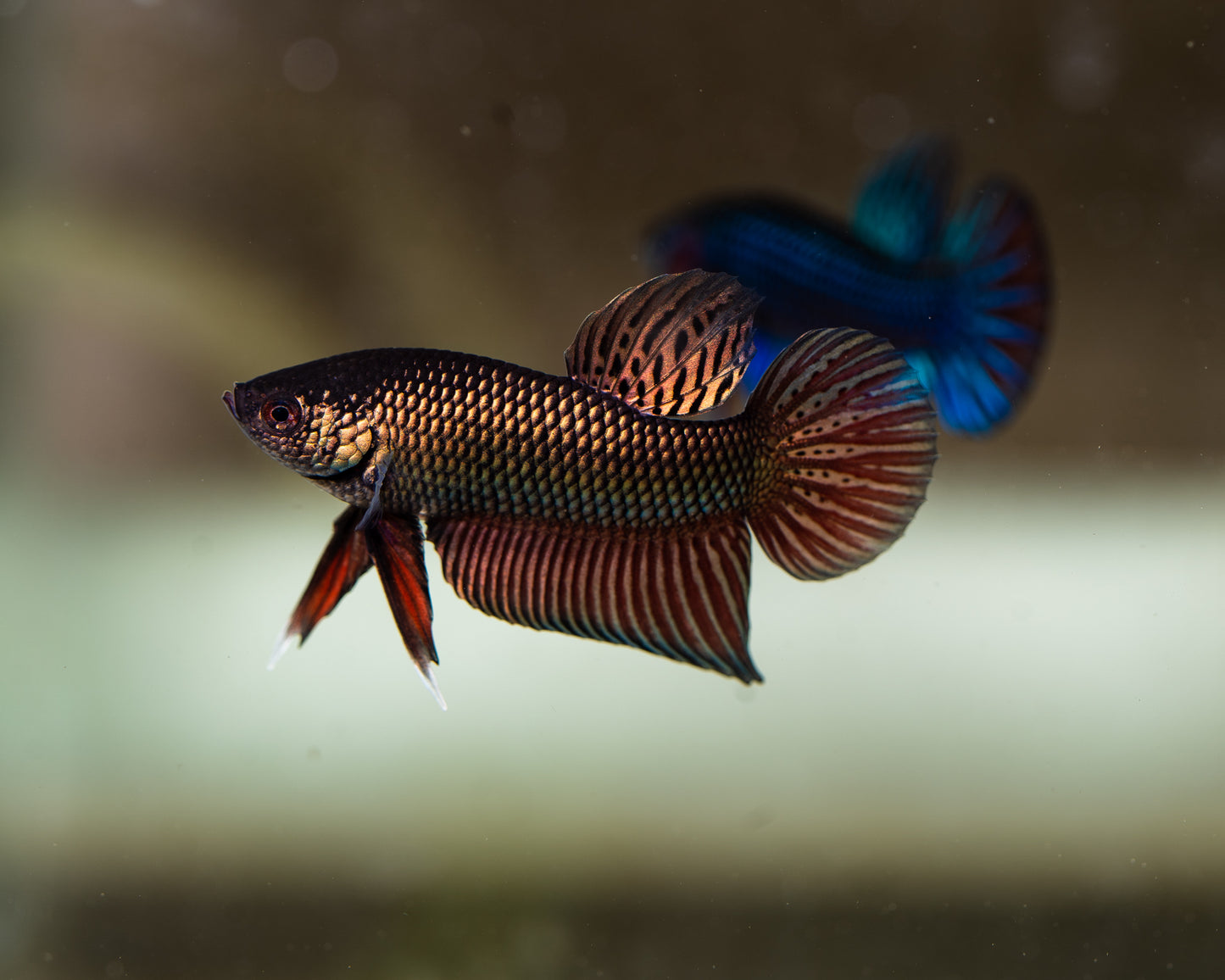
Betta Smaragdina "Copper" is a color form of Betta smaragdina, with a metallic copper coloration replacing the wild green. Copper breeds true, so offspring carry the same color. Smaragdina are known for their snake-like scaling and hardiness, and they handle lower temperatures better than most splendens, which makes them a great choice for beginners.
Genes for iridescence: blbl
Genes for metallic: ++
Physical Characteristics
- Body Shape: Slender and elongated, with a streamlined, slightly compressed body. One of the larger species in the splendens complex, reaching about 2.3 inches (6 cm).
- Fins: Usually spadetail, sometimes roundtail. The caudal fin has transverse bars and lacks the red crescent-shaped band seen in some other bettas. Fins are often longer than in other wild splendens types.
- Scaling: Each body scale is outlined, with a metallic copper center, forming a snakeskin pattern from the gill plate to the tail base. The same snake-scale pattern continues onto the operculum.
- Coloration: Dark brown to black base with a metallic copper to gold shine across the body and fins. Males are the most intense. Females are duller and brownish.
- Operculum: Snake-scale pattern of metallic copper scales in males, brightest when flaring. Females have simpler, fainter markings.
- Habitat (wild Betta smaragdina): Native to northeastern Thailand, Laos and parts of Cambodia in the Mekong Basin. Lives in slow-moving, shallow water such as rice paddies, ponds, marshes and streams with dense vegetation. Prefers warm (24 to 30°C), slightly acidic to neutral (pH 5.5 to 7.5) water and uses its labyrinth organ to breathe air.
Care Guide
Temperament: Males are VERY aggressive and should be kept alone or with non-male betta tankmates. Multiple females can be kept together in a planted community tank if there is enough space.
Max Size: 2.3 inches
TDS: 60 to 200 (we keep them in soft, low-TDS water to match our wild bettas, but they tolerate a wider range)
pH: 5.5 to 7.5
Temperature: 75 to 85°F (much better coloration above 78°F). Known to withstand temperatures as low as 60°F.
Diet: Carnivorous. We currently feed live blackworms, frozen bloodworms and pellets.
Breeding: Bubblenester. The male builds a bubble nest under a floating leaf or plants and places the eggs in it after spawning. Remove the female once spawning is done. Eggs hatch in 24 to 48 hours, and the fry are free-swimming about 3 days later. Start them on infusoria, then move to baby brine shrimp. Keep the surface calm so the nest stays intact.
Share
Collapsible content
TIPS
Be sure to have the habitat ready before purchase.
SHIPPING
Shipping Monday to Wednesday for next day air.
All other items are shipped from Monday to Tuesday.
For more information please visit our shipping policy.
SUBSCRIBE TO OUR EMAILS
Be the first to know about new collections and exclusive offers.