

BWAquatics
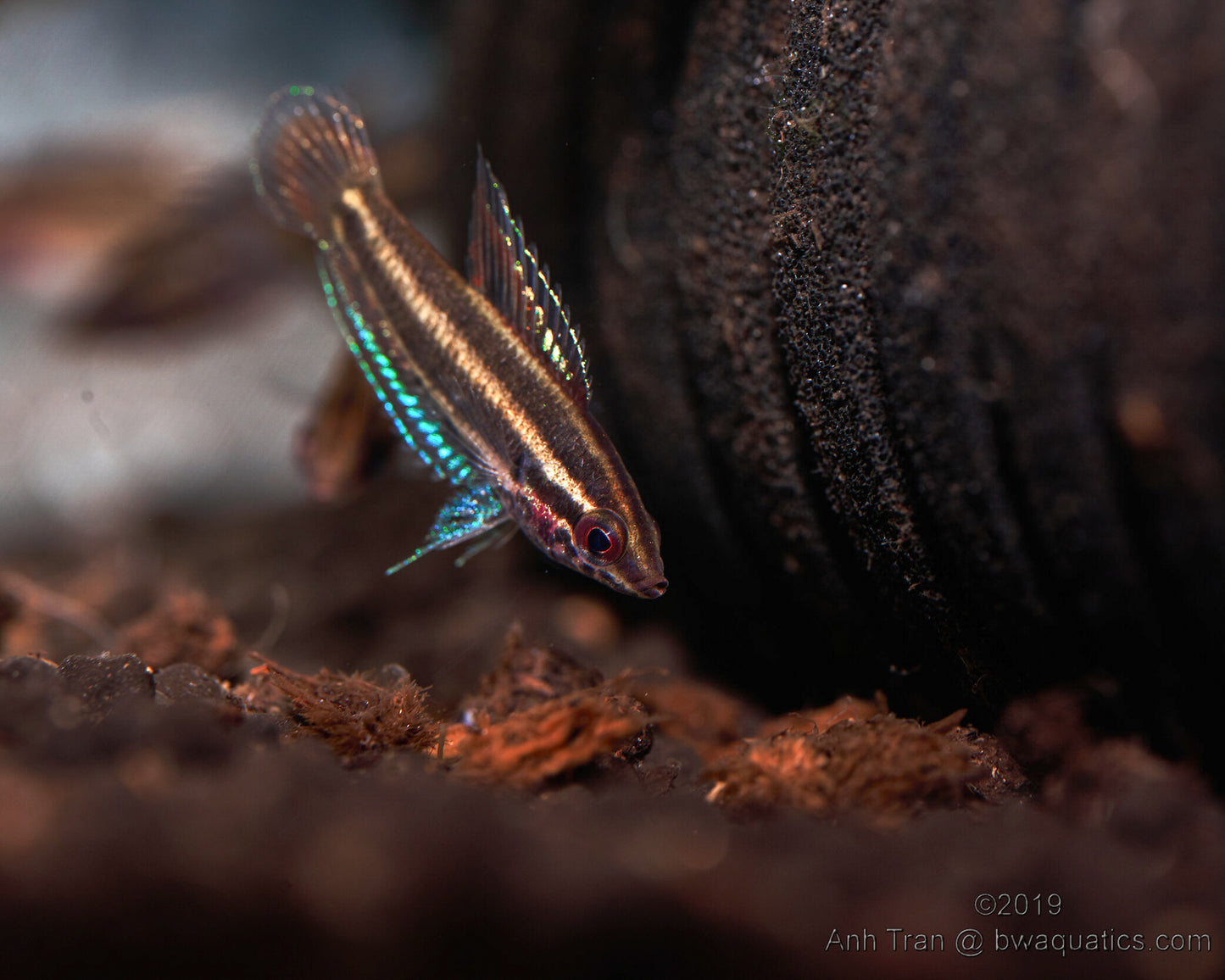
Parosphromenus Opallios
Parosphromenus Opallios
Couldn't load pickup availability
IUCN Red List: Endangered (Severely threatened by peat-swamp destruction and agricultural conversion)
Important note: These fish are wild-caught, highly specialized, and endangered. Please proceed with caution.
Parosphromenus opallios (“Opal Licorice Gourami”)
The Opal Licorice Gourami is an exceptionally rare and beautiful blackwater fish endemic to Central Kalimantan in Indonesian Borneo. Its name refers to the brilliant opalescent coloration displayed by mature males. When in breeding condition, males develop iridescent blue-green fin margins, intense blue bands, deep black markings, and rich red coloration in the dorsal, anal, and caudal fins.
This species inhabits extremely soft, acidic peat-swamp streams with almost no measurable mineral content. These waters are darkly stained by decomposing leaves and peat, with dense forest canopy allowing very little light to reach the surface. Secretive, delicate, and highly specialized, P. opallios is best maintained as a breeding pair in a dedicated blackwater aquarium. Species and habitat profile
Size:
Adults typically reach approximately 3 cm (≈ 1.2″) standard length.
Water parameters:
Extremely soft, acidic water is essential for wild-caught specimens.
pH 3.5–6.0
GH 0–3 °d
KH 0–1 °d
TDS preferably below 70 ppm
For breeding, a pH of 4.0–4.5 and very low conductivity are strongly preferred.
Use reverse-osmosis or similarly low-mineral water prepared with leaf litter and appropriate botanicals. Provide driftwood, peat-safe materials, alder cones, and multiple small caves. Filtration should be gentle, preferably using an air-powered sponge filter.
Never attempt to lower the pH rapidly. Establish the correct water chemistry before introducing the fish and monitor pH carefully when KH is nearly zero.
Temperature:
22–28 °C (72–82 °F)
Approximately 24–26 °C (75–79 °F) is suitable for routine maintenance. Avoid sudden temperature changes and maintain a warm, humid layer of air beneath a tightly fitted lid.
Food:
A specialized micropredator that strongly prefers live food.
Offer a varied diet including:
– Live baby brine shrimp
– Moina and small daphnia
– Grindal worms
– Microworms
– Small mosquito larvae
– Live cyclops and other tiny aquatic invertebrates
Frozen foods may eventually be accepted, but dried flakes and pellets are usually refused. A dependable supply of small live foods is essential for conditioning, maintaining body weight, and encouraging reproduction.
Tankmates:
Best kept as a single pair or species-only breeding group.
If tankmates are necessary, choose only tiny, peaceful blackwater fishes such as:
– Boraras
– Sundadanio
– Very small, gentle rasboras
Avoid larger fish, active feeders, shrimp that may disturb spawning caves, and territorial species.
Never mix different Parosphromenus species. Females can be extremely difficult to identify, and closely related species may hybridize. Maintaining accurate species and collection-location information is important for conservation breeding.
Breeding:
A cave-spawning species with paternal care.
The male selects and defends a small cave formed beneath leaf litter, wood, or another enclosed surface. Suitable artificial spawning sites include small clay caves, narrow tubes, or inverted photographic film containers.
During courtship, the male displays his iridescent fins and performs a distinctive head-down posture. The pair spawns inside the cave, where the eggs are attached to the ceiling. The male guards and tends the eggs until they hatch and continues guarding the larvae until they become free-swimming.
Newly free-swimming fry require microscopic foods such as:
– Paramecium
– Infusoria
– Rotifers
– Vinegar eels
– Microworms
– Newly hatched baby brine shrimp as they grow
Very soft water, abundant humic substances, and a low bacterial load are particularly important for successful egg development.
Important note:
As wild-caught Opal Licorice Gouramis, these fish require extremely slow acclimation. Match the aquarium closely to their shipping water and make any necessary changes gradually.
New arrivals may be pale, reclusive, or unwilling to eat. Provide dense cover, dim lighting, multiple caves, and live food immediately. Closely monitor for weight loss, rapid breathing, clamped fins, or disease following importation.
This species is listed as Endangered and has a highly restricted natural distribution. Its remaining peat-swamp habitat is being lost to drainage, fire, and agricultural development.
Share
Collapsible content
TIPS
Be sure to have the habitat ready before purchase.
SHIPPING
Shipping Monday to Wednesday for next day air.
All other items are shipped from Monday to Tuesday.
For more information please visit our shipping policy.
SUBSCRIBE TO OUR EMAILS
Be the first to know about new collections and exclusive offers.