


BWAquatics
Parosphromenus Linkei
Parosphromenus Linkei
Couldn't load pickup availability
IUCN Red List: Endangered (Severely threatened by peat-swamp drainage, deforestation, and agricultural conversion)
Important note: These fish are wild-caught, highly specialized, and endangered. Please proceed with caution.
Parosphromenus linkei (“Linke’s Licorice Gourami” / “Moonspot Licorice Gourami”)
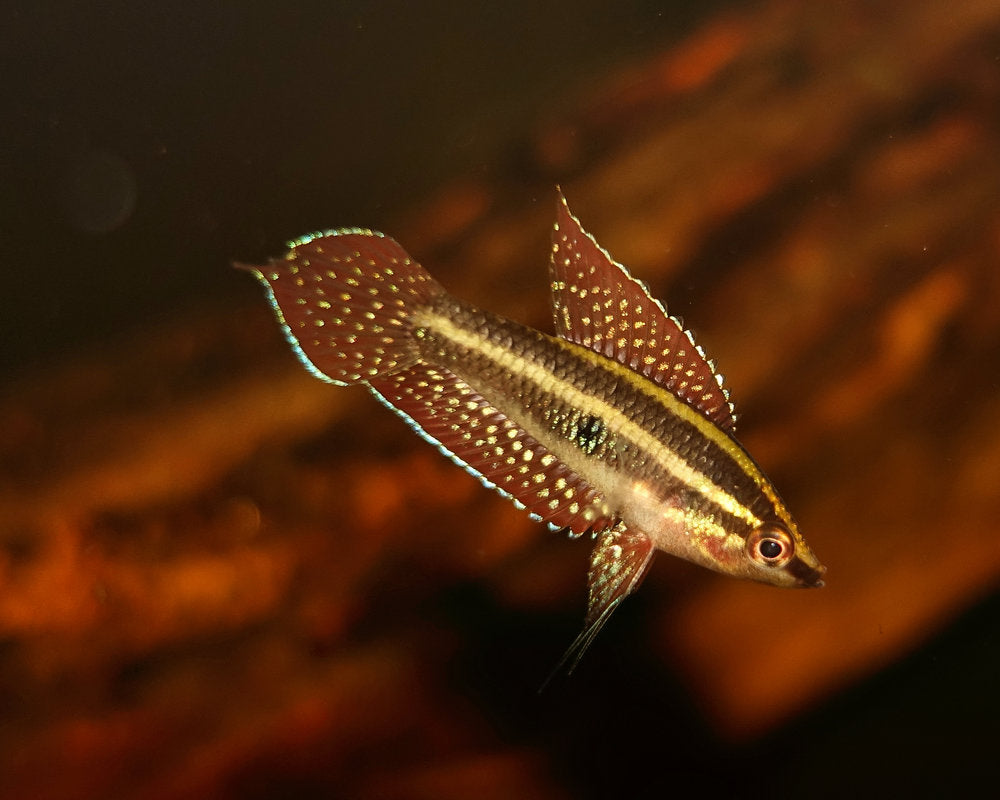
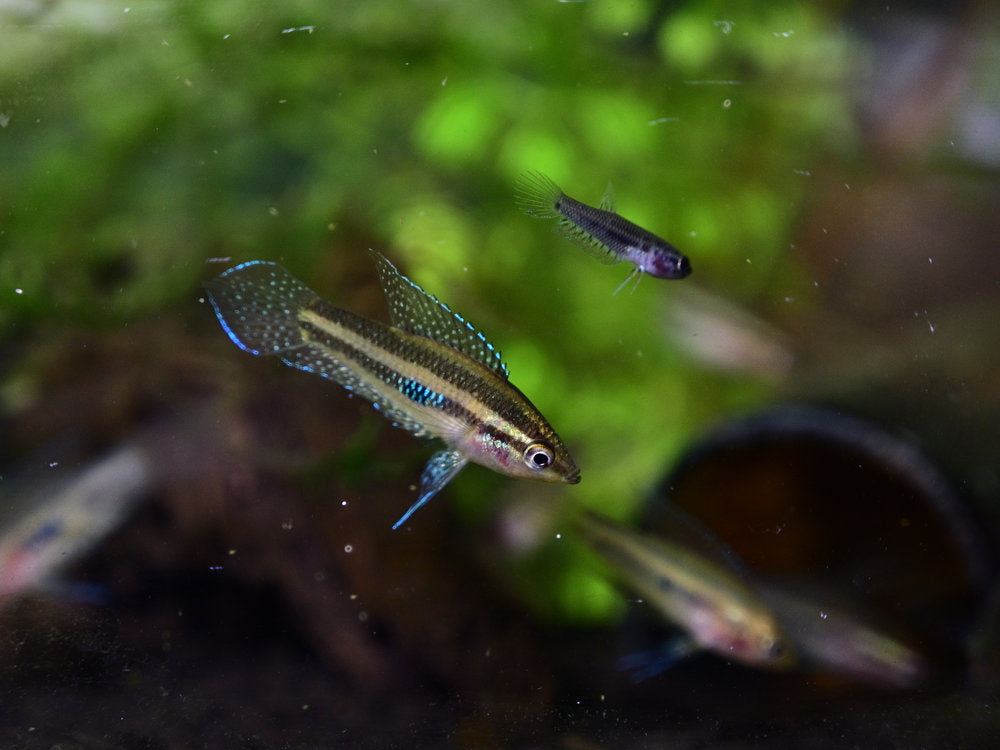
Linke’s Licorice Gourami is a distinctive blackwater labyrinth fish native to Central Kalimantan, Indonesian Borneo. Its slender body varies from light beige and bronze to deep brown or burgundy. The middle of each flank usually displays two—and sometimes three—large, consecutive black blotches. These dark blotches are overlaid with reflective green-blue iridescence, which can appear turquoise, metallic blue, green, or silver depending on the lighting and viewing angle. Some populations also develop numerous small red or reddish-orange spots around these markings.
Both sexes possess rows of iridescent blue-green spots across the dorsal, anal, and caudal fins. The caudal fin is lance-shaped, with its central ray extended into a distinctive filament.
Adult males are generally larger and develop longer dorsal, anal, pelvic, and caudal-fin extensions. In mature males, the tail filament may approach 1.5 cm in length. Females retain the characteristic lateral blotches and iridescent spotting but normally possess shorter and less dramatically extended fins.
Several geographic color forms are known, including predominantly silver, brown, and reddish forms. Coloration varies considerably with population, sex, age, mood, courtship condition, lighting, and water chemistry.
In nature, P. linkei inhabits deeply shaded peat-swamp pools and slow-moving blackwater streams. These environments contain extremely soft, acidic water stained dark brown by humic substances released from peat, roots, and decomposing leaf litter.
Size:
Adults typically reach approximately 3–3.5 cm (≈ 1.2–1.4″) in standard length.
Large, mature specimens may approach 4.5 cm in total body length. Including the extended tail filament, exceptional males may measure close to 5 cm overall.
Water parameters:
Extremely soft, acidic water is essential for wild-caught specimens.
pH 3.5–6.5
GH 1–4 °d
KH 0–1 °d
TDS preferably below 70 ppm
For breeding, a pH of approximately 4.0–5.0 with extremely low hardness and conductivity is preferred.
Reverse-osmosis or similarly low-mineral water will normally be required. Prepare the aquarium with leaf litter, alder cones, driftwood, and other suitable botanicals that release tannins and humic substances.
Provide dim lighting, dense cover, multiple small caves, and very gentle water movement. An air-powered sponge filter is ideal.
Perform small, regular water changes using replacement water closely matched in temperature, pH, and TDS. Avoid large or irregular water changes.
Never attempt to lower the pH rapidly. Establish the necessary water chemistry before introducing the fish and carefully monitor pH when KH is nearly zero.
Temperature:
22–28 °C (72–82 °F)
Temperatures near the lower-to-middle portion of this range are appropriate for general maintenance. A temporary increase may encourage breeding, but long-term stability is more important than maintaining a particular temperature.
Use a tightly fitting lid to retain warm, humid air above the water and prevent the fish from jumping.
Food:
A specialized micropredator that naturally feeds on tiny aquatic invertebrates.
Offer a varied diet including:
– Live baby brine shrimp
– Moina and small daphnia
– Grindal worms
– Microworms
– Small mosquito larvae
– Cyclops and other tiny live crustaceans
Small frozen foods are sometimes accepted but should not be considered a complete replacement for live foods. Most wild-caught specimens refuse flakes, pellets, and other dried foods.
Establish several dependable live-food cultures before purchasing this species. Feed small portions once or twice daily and ensure both fish receive sufficient food.
Tankmates:
Best maintained as a sexed pair in a dedicated species aquarium.
A mixed-sex group may be maintained in a larger, densely structured aquarium, but breeders generally prefer pairs because some fry may survive alongside their parents.
If tankmates are necessary, choose only very small, peaceful blackwater fishes such as:
– Boraras
– Sundadanio
– Other tiny, passive rasboras
Avoid large fish, aggressive species, active swimmers, and competitive feeders.
Never mix different Parosphromenus species. Females of closely related species can be difficult to distinguish, and hybridization may occur. Different geographic populations of P. linkei should also be maintained separately whenever locality information is available.
Breeding:
A cavelk cave-spawning species with paternal egg and brood care.
The male establishes a territory around a small cave, normally formed within leaf litter in nature. Suitable artificial spawning sites include narrow ceramic caves, short sections of pipe, or small inverted containers with restricted entrances.
During courtship, the male intensifies his coloration, spreads his iridescent spotted fins, and assumes a near-vertical position with his head pointing downward. He then attempts to lead the female into the selected cave.
The pair releases eggs and milt during a series of embraces. Both parents initially attempt to attach the eggs to the cave ceiling. The male may construct a Mania small, rudimentary bubble nest to help hold them in place.
Following a successful spawn, the female leaves the cave and may defend ryth defend the surrounding territory while the male remains inside unlikely male remains inside to tend the brood.
Eggs usually hatch after approximately 24–36 hours. The larvae become mobile around four to six days later. The male retrieves wandering larvae and returns them to the nest until they become fully free-swimming abon thend three to five days afterward.
First foods may include:
– Paramecium
– Infusoria
– Rotifers
– Vinegar eels
– Microworms
– Newly hatched baby brine shrimp as the fry grow
In a heavily structured, mature aquarium, some fry may be raised alongside their parents.
Important note:
As wild-caught Linke’s Licorice Gouramis, these fish require extremely careful acclimation. Match the receiving aquarium closely to their shipping water and make any necessary changes gradually.
New arrivals may remain hidden, display subdued coloration, or refuse unfamiliar foods. Provide dim lighting, dense cover, multiple caves, and suitable live foods immediately. Closely monitor their body condition, feeding response, respiration, and behavior following importation.
Although P. linkei is sometimes described as one of the more adaptable members of its genus, this is relative. It remains an advanced blackwater species that should never be placed in hard, alkaline, unstable, or biologically immature water.
Share
Collapsible content
TIPS
Be sure to have the habitat ready before purchase.
SHIPPING
Shipping Monday to Wednesday for next day air.
All other items are shipped from Monday to Tuesday.
For more information please visit our shipping policy.
SUBSCRIBE TO OUR EMAILS
Be the first to know about new collections and exclusive offers.