

BWAquatics
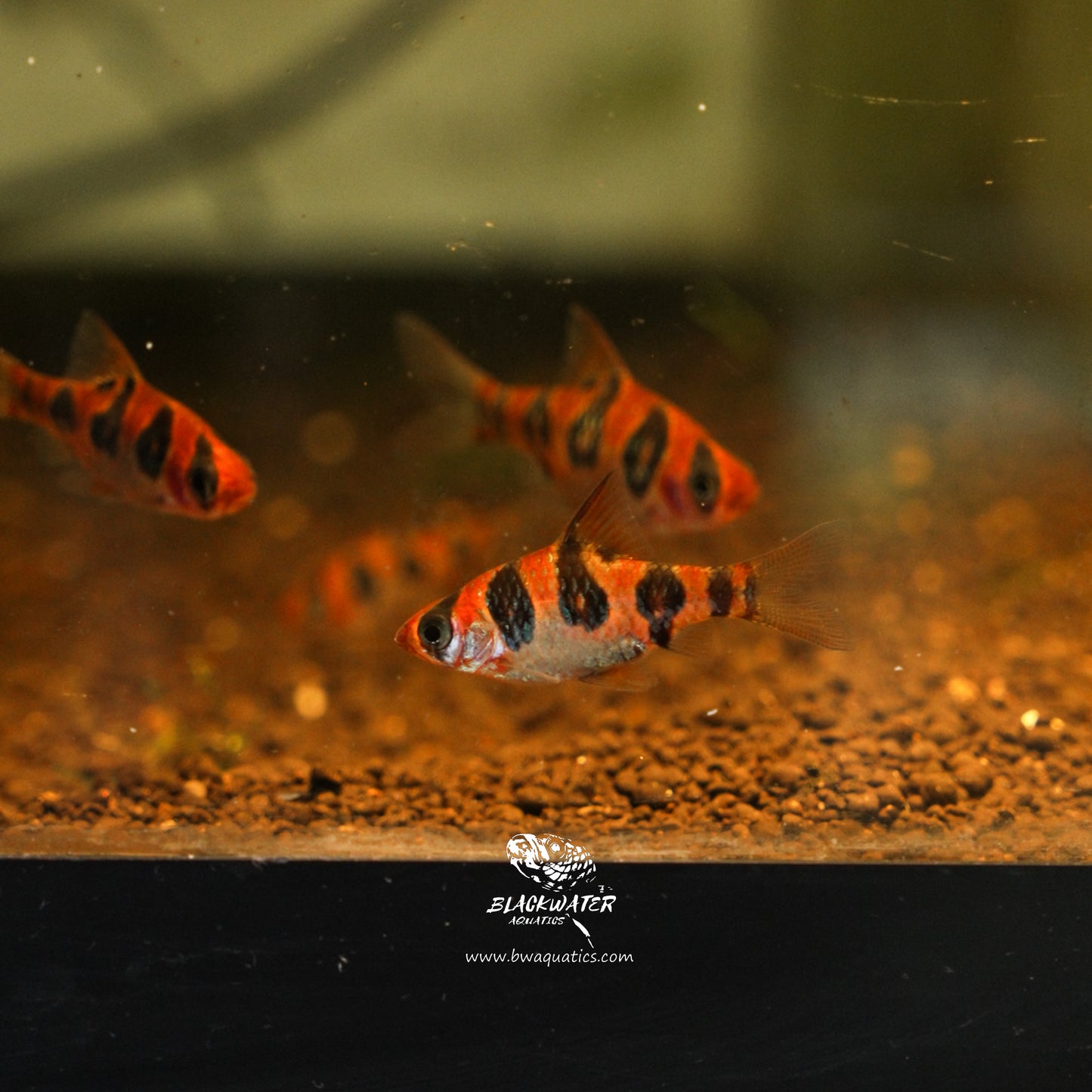
Desmopuntius rhomboocellatus aka "Snake skin" Barbs
Desmopuntius rhomboocellatus aka "Snake skin" Barbs
Couldn't load pickup availability
From the Desmopuntius genus (banded barbs).
IUCN Red List: Least Concern (locally threatened by peat swamp habitat loss)
Origin: Wild caught
Important note: These fish are wild-caught, please proceed with caution.
Desmopuntius rhomboocellatus (Snakeskin Barb)
Desmopuntius rhomboocellatus is a rarely imported soft-water barb from southern and western Kalimantan, Borneo, recorded from the Kapuas, Kahayan, Barito and Kepayang drainages. It lives in slow, heavily tannin-stained peat swamp streams under forest canopy with deep leaf litter. Its name comes from the dark, ring-shaped rhomboid markings on a warm orange-red body that give it a snakeskin look. Groups kept in stable, mature blackwater show the strongest color.
Physical Characteristics
- Body Shape: Deep, compressed barb body.
- Fins: Red-orange fins in adults.
- Coloration: Orange-red to golden body covered in dark rhomboid rings in an irregular, reticulated pattern.
- Habitat: Slow, shaded peat swamp streams with leaf litter.
Care Guide
Temperament: Peaceful schooling fish. Keep in groups of 6 to 12 or more; small groups become shy and lose color. Good with Boraras, Sundadanio, small rasboras and peaceful loaches. Avoid fin-nippers and fast, boisterous fish.
Max Size: Usually 2 to 2.4 in; up to about 3.5 in total length
Tank: Leaf litter, botanicals, driftwood and dim light. Gentle current is fine.
TDS: Under 120 ppm
pH: 4.5 to 6.5
Temperature: 75 to 82°F
Diet: Prefers small invertebrates. Live or frozen daphnia, brine shrimp, bloodworms and mosquito larvae, plus micro pellets, soft granules and small flakes.
Health: Wild fish can be sensitive during acclimation. Avoid sudden changes in pH or hardness and give plenty of cover.
Breeding: Egg scatterer with no parental care. Adults eat eggs, so use a separate tank with mesh or marbles on the bottom and fine plants. Eggs hatch in about 24 to 36 hours; feed infusoria first, then baby brine shrimp.
Share
Collapsible content
TIPS
Be sure to have the habitat ready before purchase.
SHIPPING
Shipping Monday to Wednesday for next day air.
All other items are shipped from Monday to Tuesday.
For more information please visit our shipping policy.
SUBSCRIBE TO OUR EMAILS
Be the first to know about new collections and exclusive offers.