

BWAquatics
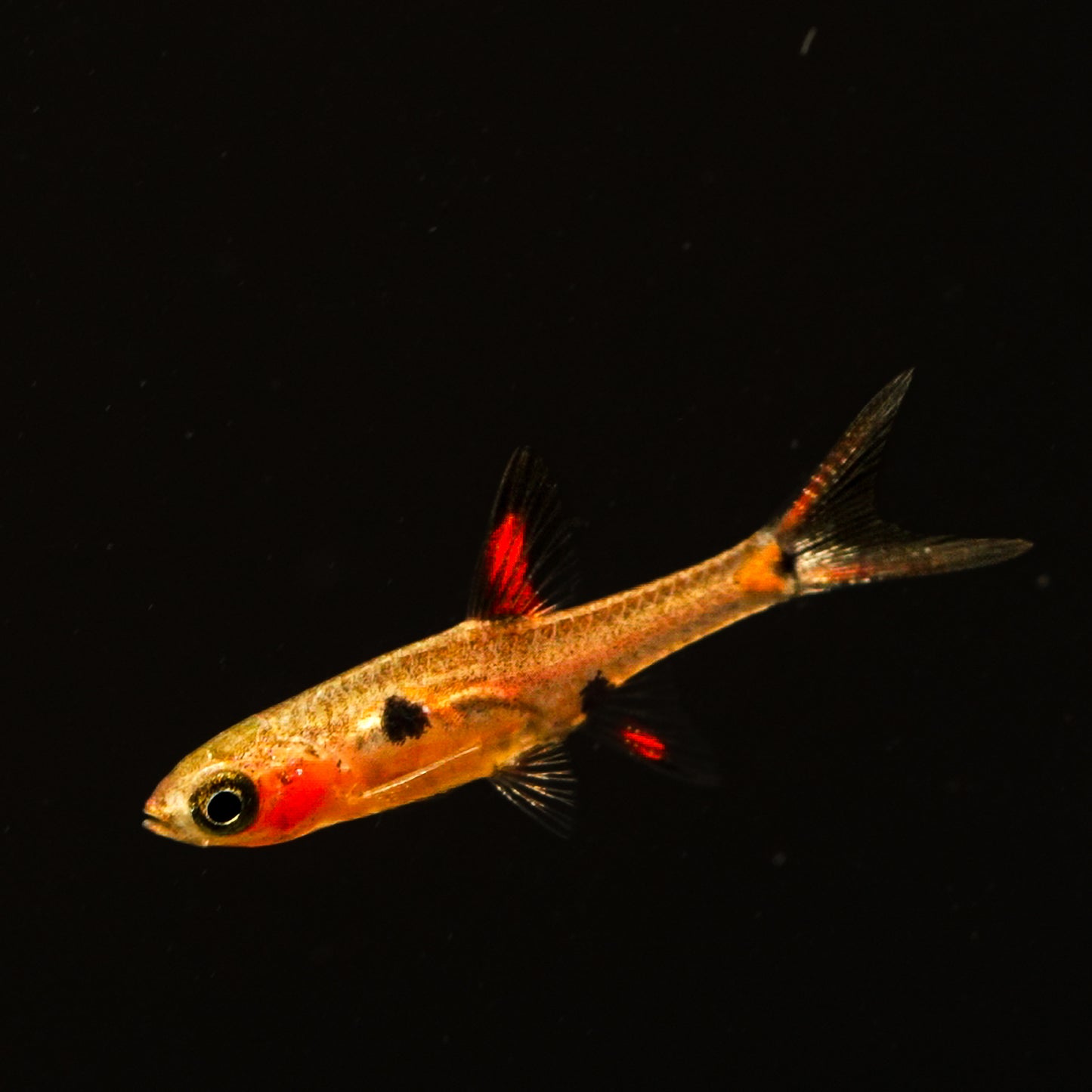
Boraras maculatus (“Dwarf Rasbora” / “Spotted Rasbora”)
Boraras maculatus (“Dwarf Rasbora” / “Spotted Rasbora”)
Couldn't load pickup availability
Imported on October 17, 2025 — shipping begins on October 26, 2025
Boraras maculatus (“Dwarf Rasbora” / “Spotted Rasbora”) — Sumatra Population
The Sumatran form of Boraras maculatus is a tiny, vividly colored blackwater species found in the peat-swamp forests and forest-edge streams of southern and eastern Sumatra, Indonesia. These habitats are shaded by dense forest canopy, with dark, tannin-rich water, minimal current, and heavy accumulations of decaying leaves and branches. In this environment, B. maculatus has evolved to display intense copper-orange to red hues and a distinct dark lateral spot, creating beautiful contrast against the blackwater background.
Size:
Adults reach approximately 1.5–2 cm (≈ 0.6–0.8″) in total length.
Water parameters:
Soft, highly acidic blackwater is essential to replicate its native peat-swamp habitat.
pH 4.0 – 6.5
GH ≤ 5 °d
KH ≤ 2 °d
TDS < 100 ppm
Provide slow or still water with leaf litter, driftwood, and fine plants. Subdued lighting and a dark substrate will deepen body coloration and reduce stress.
Temperature:
22 – 28 °C (72 – 82 °F); optimal range 25 – 26 °C for long-term health and breeding.
Food:
Micropredator — feeds on small aquatic crustaceans, insect larvae, and zooplankton in the wild.
In captivity, offer finely crushed flakes, high-quality micro-pellets, and live or frozen foods such as baby brine shrimp, cyclops, and microworms. Multiple small feedings per day are ideal.
Tankmates:
Exceptionally peaceful; best kept in a species-only or nano community setting with other tiny, gentle fish.
Excellent companions include Boraras brigittae, Sundadanio axelrodi, Pseudomugil luminatus, or small Caridina shrimp.
Avoid large or active species that may outcompete them for food.
Breeding:
An open-water egg scatterer. Spawning occurs among fine plants, moss, or leaf litter.
Use very soft, acidic water and subdued light.
Adults may eat eggs; remove them after spawning.
Eggs hatch within 36–48 hours, and fry become free-swimming after 3–4 days.
Feed infusoria or liquid fry food at first, then transition to baby brine shrimp as they grow.
Important note:
This population originates from Sumatra’s peat-swamp systems, where water is extremely soft and acidic.
Keep in groups of at least 10–12 individuals — schooling behavior enhances both color and confidence.
They thrive in low light, with blackwater conditions and botanical cover.
Though small, they are energetic swimmers that display best in open midwater space surrounded by dense vegetation.
-------------------------------------------------------------
A very small nano black water fish that inhabit black water swamps. They belong to the family Cyprinidae and are some of the smallest fish in the aquarium trade. They make great tank mates for other black water fishes such as licorice gouramis or small mouthbrooding bettas like Betta Channoides and Albimarginata. Their best coloration comes when you have them in dimly lilted habitat stained with tannins. They prefer soft acidic water with ph as low as 4.5. To have the best coloration it is prefer that you keep them in schools of 10 or more.
Difficulty: intermediate, they are easy to keep once the aquarium is stable. But due to their small delicate nature and the fact that they required soft water to really thrive. They are not recommended for beginners.
Distribution and habitat: Malaysia, Indonesia (Sumatra) and South-east Thailand. Black waters in peat swamp forests.
Size: Boraras maculatus typically reach a maximum size of 2.5 cm (1 inch) in length, making them one of the smallest aquarium fish.
Appearance: The body of Boraras maculatus is elongated with a golden or yellow color along its body. They have a distinctive pattern of dark spots along their sides and a red or orange stripe on their fins.
Tank requirements: Prefer a densely planted aquarium with plenty of hiding places, such as rocks and driftwood.
PH: 4.5 - 6.5
TDS: 0-60
water temperature: of 22-26°C (72-79°F)
Diet: In the wild, Boraras maculatus feed on small invertebrates and insects. In the aquarium, they will accept a variety of foods, including flake food, freeze-dried or frozen foods, and small live foods such as brine shrimp or daphnia.
Behavior: Boraras maculatus are peaceful and social fish that do well in small groups of 6-8 individuals. They are active swimmers and spend most of their time in the middle and upper levels of the aquarium.
Breeding: Dwarf Rasboras are egg-layers and breeding can be difficult in captivity. They require very soft and acidic water, as well as a densely planted aquarium with fine-leaved plants such as Java moss.
Share
Collapsible content
TIPS
Be sure to have the habitat ready before purchase.
SHIPPING
Shipping Monday to Wednesday for next day air.
All other items are shipped from Monday to Tuesday.
For more information please visit our shipping policy.
SUBSCRIBE TO OUR EMAILS
Be the first to know about new collections and exclusive offers.