

BWAquatics
Betta Ocellata "Malinau" | Wild Type Bettas
Betta Ocellata "Malinau" | Wild Type Bettas
Couldn't load pickup availability
From the Betta Unimaculata Complex.
IUCN Red List: Least Concern (lowest risk category)
Origin: Wild caught (Malinau, North Kalimantan)
Betta ocellata "Malinau"
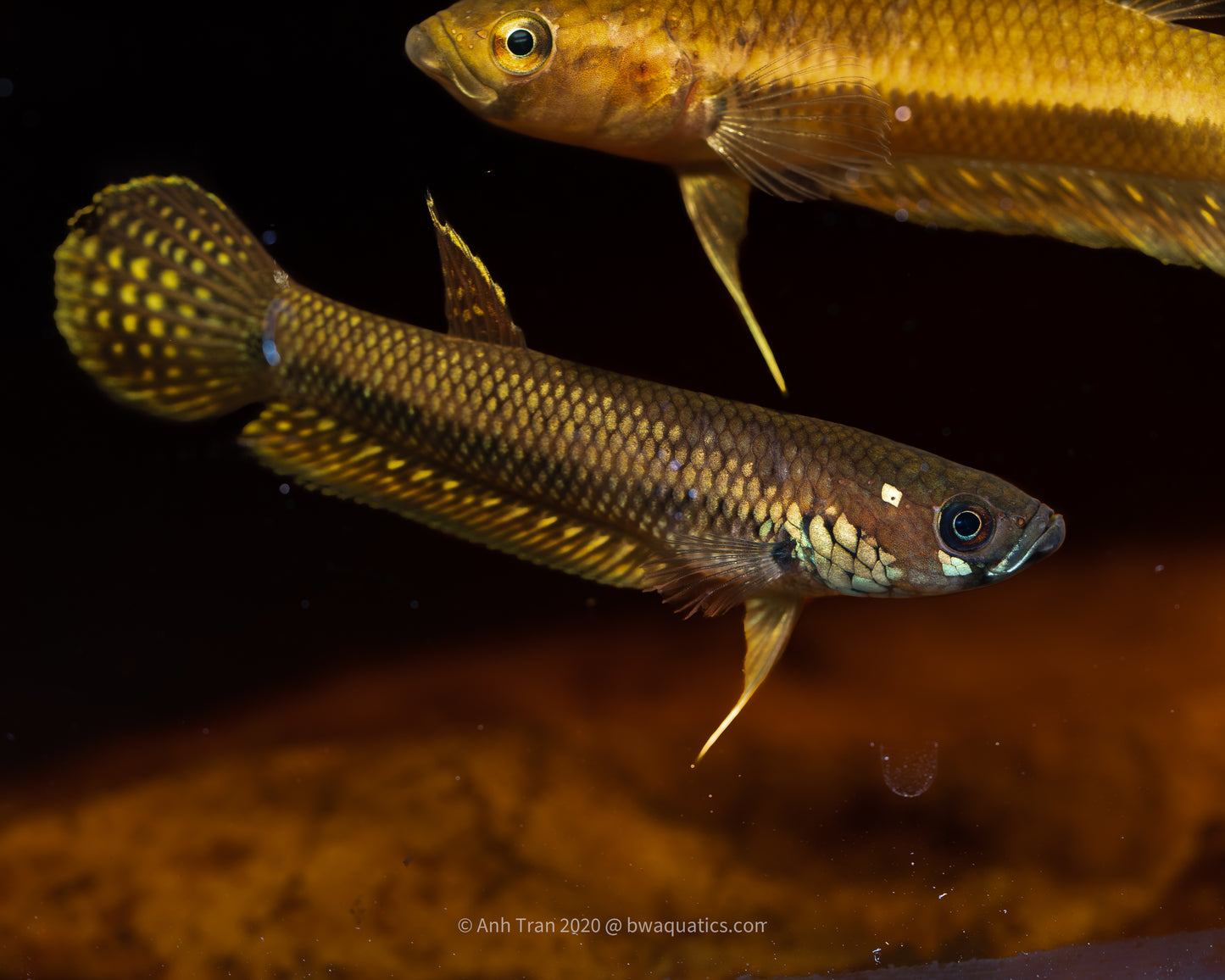
Betta ocellata was described in 1933 and is native to Sabah in northeastern Borneo and the far north of Kalimantan, where published records come from the Sebuku River basin. This group was supplied as coming from Malinau, a little south of the published range. It is told apart from other unimaculata-complex species by a distinct black spot near the base of the tail and a blue gill plate.
Physical Characteristics
- Body Shape: Long, slender, almost worm-like body with a large, blunt head. Fully grown males have larger bodies.
- Fins: Evenly colored caudal fin without bars. Fully grown males have longer pelvic fins.
- Scaling: Light blue iridescent scales on the gill plates and lower jaw, with scattered iridescent scales along the body.
- Coloration: Light brown to tan body with light blue iridescence on the cheeks, lower jaw, body and fins, and a black spot near the tail base. Females have less iridescence and often show two dark lateral bands.
- Habitat (wild Betta ocellata): Slow-flowing parts of forest streams, ox-bow lakes and isolated pools, among leaf litter, roots and floating leaves. They are excellent jumpers.
Care Guide
Temperament: Aggressive. Best kept in a species-only tank, since they will eat any fish that fits in their mouth. Give a pair plenty of caves and cover to break line of sight, and keep a tight lid. Recommended 1 pair per 10 gal, or 20 gal for breeding.
Max Size: 3 to 4 inches
TDS: 60 to 100
pH: 5.0 to 7.0
Temperature: 72 to 82°F (they prefer cooler water, but warmer water brings out color and breeding behavior)
Diet: Carnivorous. We currently feed live blackworms, frozen bloodworms and pellets.
Health: In our experience, fish in this complex are very prone to ich and velvet during the first few weeks after import, so watch new arrivals closely.
Breeding: Paternal mouthbrooder. The female collects the eggs during spawning and passes them to the male, who holds them in his mouth for about 2 to 3 weeks. Keep the tank quiet and leave a holding male alone, since a disturbed male may swallow or spit out the brood. He releases fully formed fry that can eat baby brine shrimp right away.
Share
Collapsible content
TIPS
Be sure to have the habitat ready before purchase.
SHIPPING
Shipping Monday to Wednesday for next day air.
All other items are shipped from Monday to Tuesday.
For more information please visit our shipping policy.
SUBSCRIBE TO OUR EMAILS
Be the first to know about new collections and exclusive offers.